· 5 min read
In this post
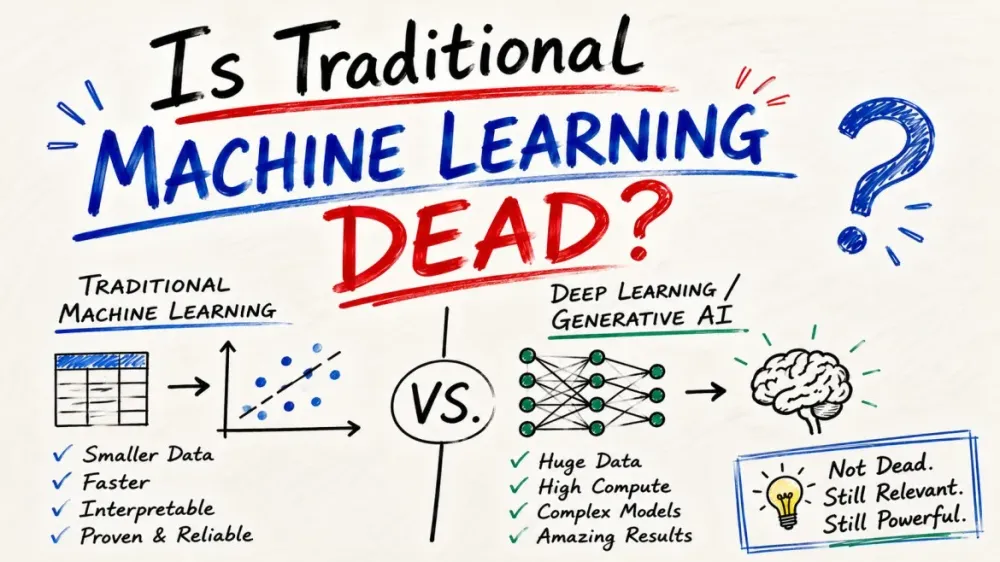
Okay so lately there's been a lot of noise on the internet - Reddit posts, YouTube videos, LinkedIn rants - all asking the same thing: is Machine Learning dead? And honestly, I get why people are asking. AWS just discontinued their ML certification and replaced it with a Generative AI one. That hit different.
And then there are developers who've spent years grinding through logistic regression, support vector machines, random forests, backpropagation - all of it - only to feel like the whole thing became useless overnight. One guy on Reddit put it perfectly: "Why bother deriving gradients when every company just wants you to call a damn API and magically get results that blow your handcrafted model out of the water?"
Honestly? That frustration makes sense. But the conclusion is completely wrong.
So What Did Gen AI Actually Change?#
Before 2022, if you wanted to build something even as simple as a sentiment analysis tool for production, you were looking at weeks of work. You needed someone to collect the data, someone to clean it, someone to engineer the features, someone to train the model, and then someone to deploy it. Different people, different expertise, long pipeline.
Then LLMs showed up and basically collapsed all of that. Suddenly, text classification, customer query handling, product review analysis - stuff that used to take entire engineering sprints - could be done with a well-written prompt. Startups especially jumped on this. They didn't have big budgets, didn't have large teams, so they just grabbed an OpenAI API key, wrapped it into their product, and shipped. No ML engineer needed.
And yeah, that's wild. But here's the thing people keep missing -
Gen AI didn't kill ML. It literally IS ML.#
This is the most important point and almost everyone glosses over it. Generative AI is not some separate alien technology that appeared out of nowhere. Deep learning is a subset of machine learning. LLMs are built on top of deep learning. So when you say "ML is dead because of Gen AI," you're basically saying biology is dead because of medicine. It doesn't even make sense.
Gen AI is ML's most successful child. That's it.
Let's Talk Numbers for a Second#
Here's something nobody is making reels about - the traditional ML market in 2025 is worth around $95 billion. Generative AI? About $7.8 billion. ML is literally 12 times bigger right now. Twelve times.
Enterprise AI spending hit $37 billion in 2025 alone, and it's growing at an insane rate - 3.2x compared to 2024. But most of that is companies using AI APIs and tools, not replacing ML systems that are already running perfectly fine under the hood.
The reason Gen AI feels so dominant is because it's easy to show off. You build a chatbot, you demo it, people go wow. Classical ML is invisible. It's running in the background of apps you use every day, silently doing its job.
Places Where Traditional ML is Still Running Everything#
Netflix's recommendation system - pure ML, no LLM anywhere near it, and it saves them over a billion dollars a year just by keeping people from cancelling their subscriptions.
Every UPI transaction you make - there's an ML model running in milliseconds in the background, checking if it looks like fraud.
60% of US hospitals are already using ML in clinical care. Not Gen AI. ML.
Zomato, Swiggy - that delivery time prediction you see? Classic ML. Not generative anything.
These aren't small use cases. These are billion-dollar systems built on the exact fundamentals people are calling outdated.
The Startup Reality Nobody Warned You About#
So yeah, a lot of startups went all-in on the "just call an API" approach. And in the beginning it worked great. But then scale happened.
When you go from 10,000 users to millions, every single API call multiplies. Analysis showed that 40 to 60 percent of LLM API budgets were going to pure waste - not even actual usage. And now those same startups are coming back to fine-tuning their own models.
Fine-tuning with something like LoRA gives you around 40% cost reduction compared to raw API calls. But here's the catch - to fine-tune a model, you need to actually understand machine learning. Loss functions, overfitting, how training works - you can't skip that. There's no shortcut version.
What's Actually Changed (And What Hasn't)#
ML in 2026 is not ML in 2019. That's true. But evolution isn't death. The tools changed, the job titles shifted a bit, the workflows look different - but companies are still asking about Random Forests, Gradient Boosting, precision vs recall in interviews right now. In 2026. These aren't going away.
The thing is, if you only know how to call an LLM API, you literally cannot make the call of when to use ML vs Gen AI. And that decision matters a lot - wrong tool for the job means wasted money, bad performance, or systems that break at scale. The person who understands both is the one companies actually want to hire.
So What Should You Actually Do?#
Start with ML fundamentals. Not because it's old school, but because everything else builds on top of it. Logistic regression, SVMs, Random Forests, CNNs, the math behind them - get comfortable with all of it.
Once that's solid, layer in Gen AI. LangChain, LangGraph, RAG pipelines, prompt engineering - this stuff is genuinely exciting and worth learning.
Then the most valuable skill: knowing when to use which. Structured data, tabular predictions, real-time systems - that's ML territory. Open-ended language tasks, chatbots, content generation - that's where LLMs shine.
And please, stop reading those "X is dead" articles. RAG is dead. ML is dead. Traditional coding is dead. Something is always dying on the internet. None of it is actually dying. The field is just moving fast and people confuse motion with extinction.
The best engineer in 2026 knows both. Knows when to use which. And doesn't panic every time a Reddit post goes viral.
That's it. That's the whole thing.
Originally published on AWS Builder Center.